Ask a UK accounting firm partner what worries them most about outsourcing production work, and the answer is almost always some version of the same two things. Will quality slip. Will clients notice.
Both are reasonable questions to ask before handing files to a team you have never met. Sounds reasonable, right? But that is rarely how the first few months of a working arrangement actually go. Having watched this transition play out across enough firms, a pattern repeats often enough to be worth setting out plainly, and it has very little to do with the offshore team itself.
The Early Weeks Are About Access and Trust, Not Results
The first few weeks of an outsourcing arrangement rarely look like the arrangement everyone pictured going in. Nobody is measuring turnaround time in week one. The work is systems access, software logins, style guides, and a first batch of files handed over cautiously, the kind a firm would still check closely even if a new in-house junior had prepared them.
Both sides are learning how the other works. The offshore team is learning the firm's chart-of-accounts conventions, its client quirks, and what "flag this, do not guess" actually means in practice. The firm is learning how to write a brief clear enough that the work comes back right the first time. That calibration period is not a delay before the real arrangement starts. It is the real arrangement, in its earliest and most fragile form.
The Quality Worry Doesn't Disappear on Day One. It Fades.
Partners who go in expecting a single moment where they suddenly trust the arrangement are usually disappointed, because that moment rarely arrives as one event. What happens instead is more gradual, and in a way more convincing. Senior review sits over every file in the first weeks, the same as it would over a new in-house hire's early work. As file after file comes back clean, that review shifts from a leap of faith into a routine step, the same routine step it would eventually be for any established team member.
The mechanism doing the work here is not just the offshore team getting faster, although that happens too. It is the firm's own review process becoming explicit, tested, and trusted through repetition rather than assumed through familiarity. Many firms never had that process written down before outsourcing forced the question.
Outsourcing does not create the quality question. It surfaces how much of a firm's senior time was already going to work that did not need a senior person to do it. That is the number worth actually knowing before year one starts, whatever the answer turns out to be.
The "Will Clients Notice" Worry Resolves the Same Way
The honest answer to whether clients notice is: only if something changes for them. If work keeps arriving on time, to the standard they are used to, most clients simply stop asking who did it, in the same way they never asked which junior in the office prepared their bank reconciliation. The firm stays the single point of contact. The relationship, the sign-off, and the responsibility all stay exactly where they were.
Firms that handle this worry badly tend to make the same mistake: treating the arrangement as something to hide rather than something to manage quietly and competently. There is no legal requirement to disclose where preparation work happens, and clients care about outcomes, not org charts.

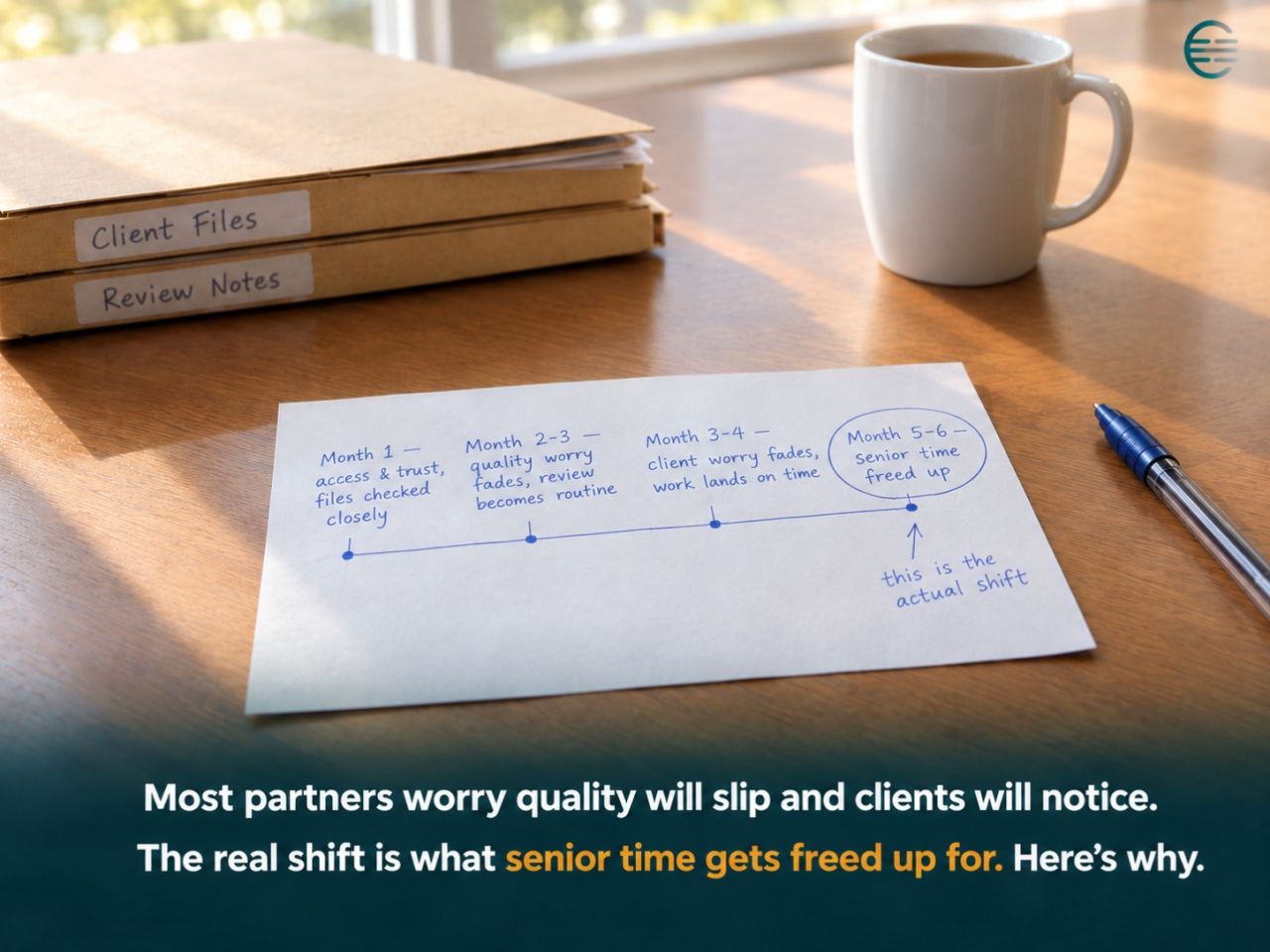
What the First Few Months Actually Look Like
Weeks 1 to 2: Access and setup
Software logins, style guides, and a first handful of files handed over with the same caution a firm would apply to any new hire.
Weeks 3 to 6: Close review becomes the norm
Every file gets checked. The review is not yet a formality. It is a genuine test of whether the work coming back holds up.
Months 2 to 3: Trust builds through repetition, not a single decision
Senior review shifts from a leap of faith into a standard step, verified file by file rather than granted upfront.
Month 3 onward: The real shift shows up
Not in the outsourced work itself, but in where the firm's senior time goes next.
The Shift That Actually Matters Isn't the Outsourced Work
By a few months in, the change most firms notice is not in the work that got outsourced. It shows up somewhere they were not watching: in what the firm's own senior people are suddenly free to do instead.
A partner who was reviewing bookkeeping at eight in the evening starts having the advisory conversation they had been putting off. A manager who was buried in VAT prep starts training the junior they never had time for. None of that happens because the offshore team is doing brilliant work, although it usually is. It happens because routine production work stops occupying hours that only a senior person's judgement could actually use.
The pattern is not really about the offshore team at all. It is about what a firm's best people get their time back for.
Is your best person spending time on work only they can do?
EarthOne builds outsourced accounting support around exactly this kind of transition, published pricing, one month's notice, and senior review built in from week one.
Book a free 30-minute consultation