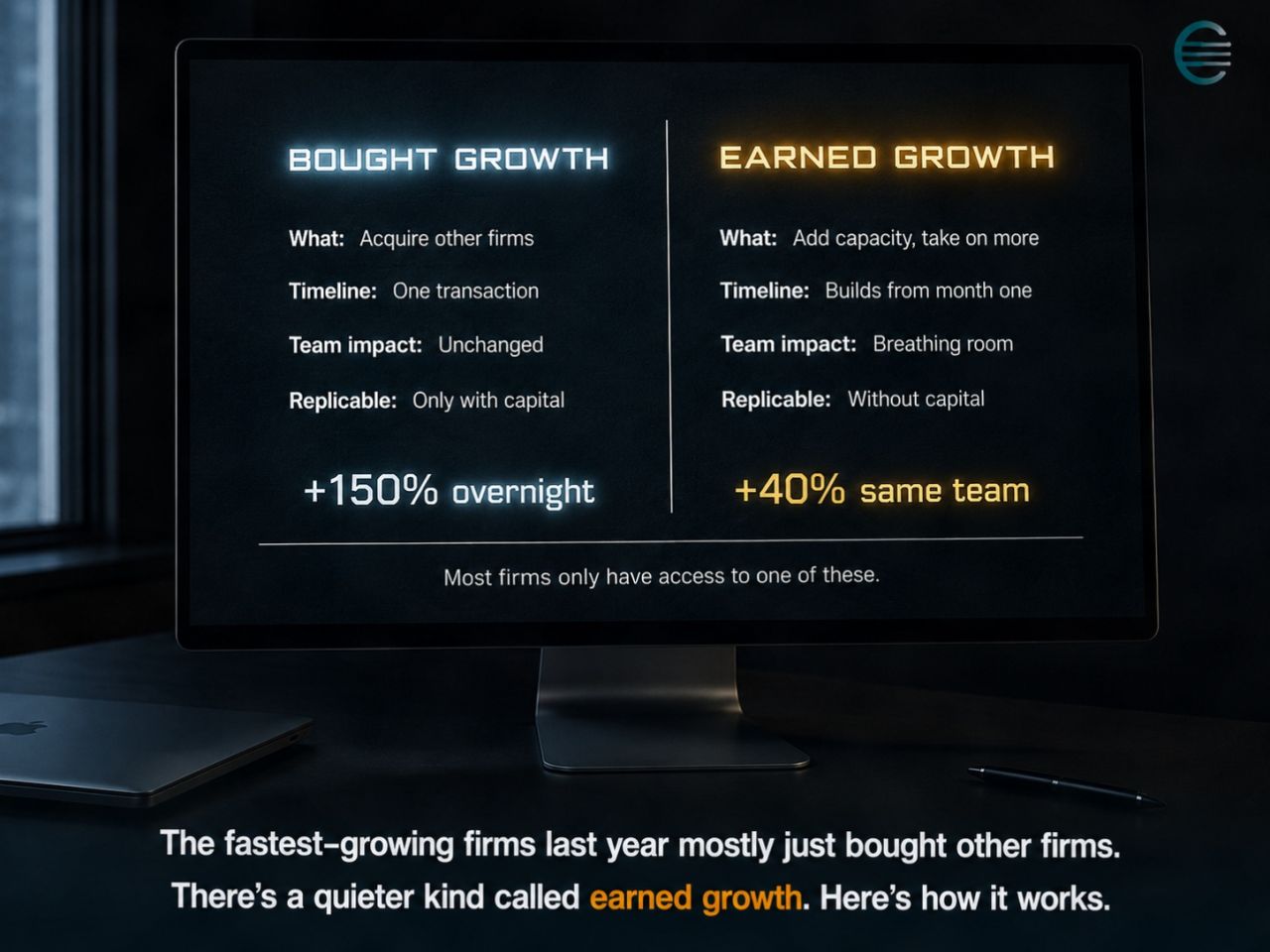
Bought growth and earned growth produce the same line on a fee-income chart. They are built completely differently, and only one of them is open to a firm without acquisition capital behind it.
Bought growth is acquiring another firm's client book in a single transaction. The team's day-to-day work doesn't change, the number just moves, and it takes capital most independent firms simply don't have. Earned growth is the opposite: the same people, taking on more client work than they could last year, with no transaction and no jump on a league table. It builds gradually, starting from month one, and it's replicable without capital because it comes from a change in how existing time gets spent, not from a cheque.
We've written before about why this year's fastest-growing firm rankings are mostly measuring acquisitions, not organic performance. This piece is the other half of that conversation: a practical playbook for building earned growth deliberately, whether or not buying another firm is ever on the table.
| Bought growth | Earned growth | |
|---|---|---|
| What it is | Acquire other firms | Add capacity, take on more |
| Timeline | One transaction | Builds from month one |
| Team impact | Unchanged | Breathing room |
| Replicable | Only with capital | Without capital |
Most firms only have real access to one of these. This is the playbook for the one that doesn't require a deal.
Step One: Find Out Where Your Capacity Is Actually Going
Earned growth doesn't start with a growth target. It starts with an honest audit of how your qualified people's hours are currently being spent. Most firms have never actually measured this. They know the team is busy. They don't know how much of that busy is bookkeeping, reconciliations and data entry that doesn't need a qualified accountant's judgement, versus how much is genuinely advisory work that does.
A simple week-long time log across the senior team, categorised into production work and judgement work, usually produces an uncomfortable number. It's the starting figure the rest of the playbook works against.
The Playbook, Step by Step
Separate production work from judgement work
Bookkeeping, reconciliations, VAT prep and routine data entry are production work. Client conversations, advisory input and sign-off are judgement work. Everything a senior person does should sit clearly in one category or the other.
Move production work off senior desks
Through outsourcing, delegation to junior staff, or both. The goal isn't to eliminate the work, it's to stop it consuming hours that only a qualified person's judgement can actually use.
Redirect the freed hours toward capacity, not relief
This is the step firms most often get wrong. Freed hours that just become a lighter workload don't produce growth. Freed hours that get pointed at new client work, or deeper advisory relationships with existing clients, do.
Track the capacity gain, not just the client count
Client numbers are a lagging indicator. The leading one is how many additional hours of senior capacity exist this quarter compared to last. Measure that directly, and the client growth follows it.
Reinvest, don't just absorb
Once a first round of freed capacity is filled with new work, repeat the audit. Earned growth compounds when each cycle of freed hours gets reinvested into the next tier of client work, rather than treated as a one-off win.
The most common failure isn't step one, it's step three. Firms free up senior time and then let it quietly get absorbed by whatever's most urgent that week, rather than deliberately pointed at new capacity. Freed time without a destination doesn't compound into growth. It just evaporates.

What "Breathing Room" Actually Looks Like Month to Month
Bought growth shows up as one number on one date. Earned growth shows up as a gradual shift that's easy to miss if you're not tracking it deliberately: a senior accountant who used to review bookkeeping at 8pm now has the advisory conversation they'd postponed. A partner who used to decline enquiries during busy weeks now has room to properly assess them. None of that is a single event worth a press release. It's the accumulation of capacity, quarter after quarter, that a bought-growth transaction can't replicate for a firm that doesn't have the capital for one.
Ready to start building capacity without buying it?
EarthOne adds qualified delivery capacity behind your existing team, on published pricing and one month's notice, so the freed hours are there from week one.
Book a free 30-minute consultation